Blog

Iddo Weiner, Converge Bio, Co-founder & CSO
|
Zero CDR Edits, 2.7× Tighter: What ConvergeAB™ Did to a Clinical Antibody
Every antibody-optimization platform has a favorable demonstration on the target it was tuned for. The harder question is what the platform does on an antibody nobody could have pre-selected to make it look good. An FDA-approved, sub-nanomolar therapeutic, already shaped by years of clinical engineering, is the most challenging version of that question. It is the antibody with no headroom left to optimize. So we ran ConvergeAB™ on one, zero-shot, no fine-tuning.
A demanding test
The target was tafasitamab (Monjuvi®), an anti-CD19 antibody approved for relapsed or refractory diffuse large B-cell lymphoma. The starting affinity was 0.56 nM, sub-nanomolar; the molecule had cleared a development program with multiple rounds of optimization, and the antigen-contact loops had been refined under exactly the kind of selection pressure that should leave no obvious moves on the board. If ConvergeAB™ produced anything measurable here, the result would mean something.
The result: 2.7× tighter on a sub-nanomolar parent
The lead ConvergeAB candidate measured 0.21 nM, a 2.7-fold improvement on a sub-nanomolar parent. That fold-change is smaller than the same engine produced on discovery-stage starting points in the same campaign (a 22.5 nM PD-L1 candidate gained 556× under identical conditions). A small fold-change on a heavily-engineered antibody is harder to deliver than a large fold-change on a loose hit; the available improvement space is what is left after every prior round of optimization.
The 0.21 nM lead came from a 12-candidate wet-lab panel: three improved on the parent KD, five matched it, four did not bind. On a sub-nanomolar, heavily-engineered antibody, candidates that simply hold the parent's binding are themselves a non-trivial outcome.Zero CDR edits
The more telling number is in the edit pattern. ConvergeAB delivered the 2.7× gain through 10 amino-acid substitutions in the lead's variable region, all of them in the framework. The complementarity-determining regions (CDRs), the loops that physically contact CD19, were preserved unchanged.
Despite identical CDR sequences, the predicted loop positions shift between parent and lead, and the shift is highly localized. H-CDR3, the loop that typically makes the strongest direct contact with the antigen, shifts an average of 2.0 Å, with the central tip residue moving 5.6 Å. The rest of the loop and the surrounding framework barely move: the framework backbone shifts only 0.4 Å.
For this campaign, ConvergeAB™ was configured to preserve the binding interface, a common partner request. Within that constraint, the platform still tightened binding through framework-level edits alone. The 2.7× affinity gain is empirical confirmation that the tip shift was a productive geometric refinement: the same contact residues, in better-tuned positions, binding the same epitope more tightly. Achieving affinity gain without touching the CDRs is technically challenging, and a capability not all generative methods have.
Region | Mean Cα shift (Å) | Signal/Noise |
|---|---|---|
Framework backbone | 0.4 | 8× |
All CDR loops | 1.1 | 17× |
H-CDR3 | 2.0 | 22× |
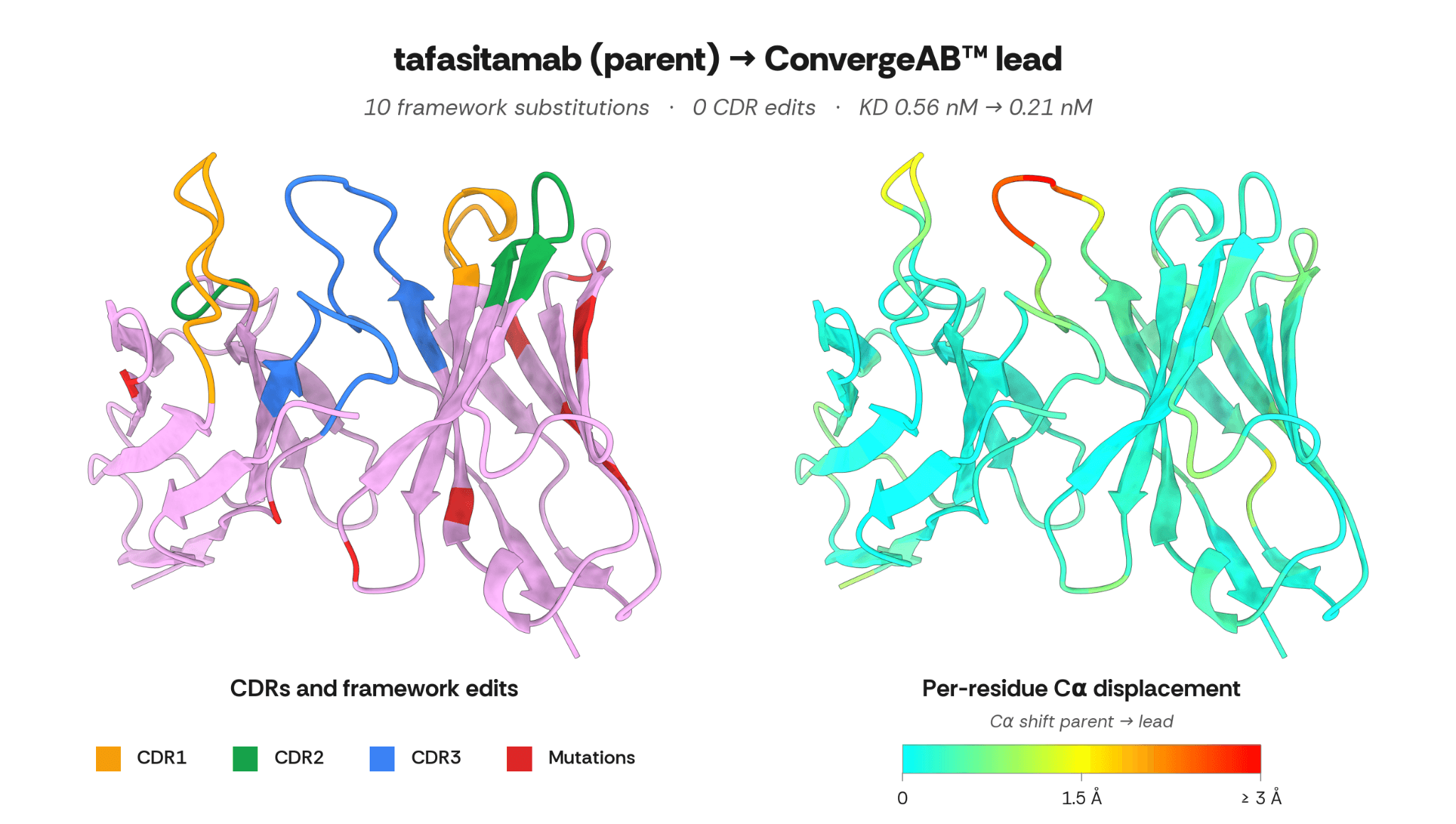
Figure 1. ABodyBuilder2-predicted Fv structures of the ConvergeAB™ CD19 lead. Left: CDR loops colored CDR1 (orange), CDR2 (green), CDR3 (blue), with the 10 framework substitutions relative to tafasitamab highlighted in red. Right: the same lead, colored by per-residue Cα displacement relative to the parent after framework-only superposition.
Developability held, drop-in replacement ready
Affinity gains that come at the cost of developability are no gains at all. The lead held or improved on three of five developability axes relative to the parent, with the other two drifting by less than the assay’s typical run-to-run variability and well inside the developable envelope. The CDRs untouched, the affinity tighter, the thermal profile improved, and no developability axis pushed out of range; the lead is a credible drop-in replacement for tafasitamab in any pipeline that already has the parent qualified for assays and formulation.
Parent (tafasitamab) | ConvergeAB™ Lead | Δ (lead − parent) | |
|---|---|---|---|
KD (nM) | 0.56 | 0.21 |
|
Thermal onset (°C) | 57.3 | 59.1 |
|
Tm1 (°C) | 67.2 | 67.9 |
|
Aggregation temperature (°C) | 72.1 | 74.3 |
|
Surface hydrophobicity (HI, RFU) | 5.2 | 6.2 | +1.0 |
% Monomer (SEC) | 96.8 | 96.2 | −0.6 |
Edits in CDR | — | 0 |
|
Edits in Framework | — | 10 |
|
What this means for partners
Tafasitamab was a hard antibody to optimize. Its CDRs had been refined through clinical development. Its starting affinity was already sub-nanomolar. And the binding interface was the source of its value, so the CDRs could not be touched without breaking the asset. ConvergeAB™ optimized it anyway. The result: a 2.7× tighter lead, with the binding interface untouched and developability preserved or improved.
For a partner with a clinical-stage program, the implication is direct: ConvergeAB can extract additional value from an asset that is already heavily optimized, without compromising the binding interface that defines it. For a partner with an earlier-stage program, the gains scale up; less heavily-optimized starting points have more room to move, and the engine moves further on them.
To see how the platform performs across antibodies at different stages of development (including tafasitamab), in a consistent and generalizable way, see the full four-target campaign.
For another example of ConvergeAB™ applied to a heavily-engineered, FDA-approved antibody, see our Cetuximab case study.