Blog

Shahar Tzafrir
|
A software VC's take on why patents are the real prize in biotech, why a good one can be worth hundreds of billions, and the one part of drug development where AI genuinely moves the needle.
There's been a run of good biotech talk on X (formerly: Twitter) lately. Dr. Yaniv Erlich's "four horsemen of death", and Maor Shlomo of Base44. writing about starting a biotech fund, out of a real sense of mission and optimism. It got me thinking, and I want to plant a flag on one thing in particular: patents.
Patents in biotech are moral and essential, and a good one can be worth hundreds of billions of dollars. That is a wild sentence if you come from software, where a patent is worth close to nothing no matter what the patent attorney is trying to sell your startup. And AI is about to change one specific corner of this, which, for the record, is a very different story from the much smaller effect AI has on clinical success rates and time to approval.
How I ended up here
For context: I'm a VC, and my background is software. I was a developer, and I was a founder who built boring SaaS. About eight years ago I found myself moving into biotech investing. Today biotech is roughly a quarter of my active portfolio: five seed investments in biotech against thirteen seed investments in "regular" software companies.
The motivation came from a few places. The main one was Aidoc, one of my seed investments. Being involved in a company that saves lives every single day gave me a kind of lift I can't compare to anything else I've felt as an investor. Making a lot of money and saving lives at the same time? That's more than double-plus good.
The other reasons were more analytical. There were almost no competitors in the local market back then, because plenty of funds had lost their shirts on biotech in the past and run for the hills. They lost their shirts because it used to be insanely expensive: you had to build a lab and burn tens of millions in CapEx before you knew anything basic at all. And software-world thinking, plus access to new kinds of biological data, had started to change how these companies get built. But all of that is a small slice of the risk/reward picture. Back to the main event: patents.
Why patents in biotech are so different
Patents in biotech are critical because a drug that works can sell billions of dollars a year. And the moment it works, the whole world knows what the right target is and which molecule hits it. With small molecules, copying is the classic move: look at the structure, manufacture it. With biologics it's a lot more complicated, but the principle is identical. Without patents, nobody would pour billions (most of which vanish) into trying to develop a new drug.
This is a textbook case of the state and the law stepping in to protect a market failure that, left alone, would kill innovation. Most people don't have an intuitive feel for how expensive and risky drug development is, how critical the IP is, and how much money a good drug prints (and good drugs are rare). There are plenty of examples of companies selling five or ten billion dollars a year of a single drug for years, and then the patent expires, sales drop 70%, and competitors walk in relatively easily. And this is moral and justified. The patent is capped in time on purpose, to balance the reward for taking an enormous risk against the good of the public.
How a drug patent actually works
So how does a drug patent work? At a very high level: a drug treats some mechanism in the body that either isn't working or is working too much. Call it the target. Finding a target is hard. But patent law has decided you can't own a target. Partly because a natural phenomenon isn't patentable in the first place, and partly because a sweeping claim like "any molecule that blocks this target" collapses under a lack of detail (the enablement requirement). What you can claim, again simplifying, is only what you actually described and taught: a specific molecule, or a defined and supported family of molecules. The real question is how wide a net you tried to cast.
So the sequence is: first you discover a target (hard!), then (crude simplification, sorry) you engineer a molecule that hits only that target, and you check a huge list of things before animal testing and after it too. Toxicity, selectivity, PK, manufacturability. You run it in a test tube, then in mice, then in larger animals, and then you move to humans. And that's often the moment you discover that whatever saved the mouse does nothing for people, and you write off hundreds of millions of dollars. If it does work, you keep going through an expensive chain of trials until approval. Then the drug is protected for the life of the patent and you can finally make money from it. How much depends on the market, meaning on the competing drugs going after the same problem.
Zooming in on antibodies and proteins
From here I want to narrow things down to antibodies and proteins, which are a growing share of the biotech world. What is that molecule, exactly? It's a sequence of amino acids. So what happens if my patent locked down only one such sequence of letters? And what happens when a competitor, who now knows the target is correct and the concept works, takes my molecule and swaps out a few letters? Two questions fall out of that. Will the drug still work? And did he infringe the patent?
Here you have to draw a line between two things. A biosimilar is a generic biological copy on a shortened path. It has to prove near-identity, and it competes on price. A biobetter is a drug redesigned from the ground up on its own independent path, aimed at the same target. It requires a full clinical program, it offers a clinical improvement (in stability, safety, or efficacy), and it earns the status of a new drug. But the huge difficulty here isn't only legal. You can't just change amino acids in a protein and cross your fingers that it still works.
The asymmetry nobody tells you about
Companies defend their patent portfolios by widening the set of molecules they hold patents on. The catch is they have to spend a lot of money editing those molecules, and some money testing them too. In the past, companies would file a broad patent on "any molecule that achieves the result." That approach went to court, and in the Amgen ruling at the Supreme Court in 2023 it was decided that you can't patent a "function." You have to name, characterize, and detail a list of specific variants. A company that doesn't map out its variant space is leaving IP on the table.
And there's an asymmetry here that actually favors the attacker. Whoever develops a biobetter and gets it approved as an independent drug receives 12 years of regulatory exclusivity of their own, starting from zero. The owner of the original drug who makes a similar structural change does not get a new clock. Put simply: the attacker fights with both patents and regulation, while the defender fights with patents alone. The defender can't use regulatory exclusivity to stop a biobetter, and has to rely on patents only to block it, while the attacker walks away at the end with patents plus fresh regulatory exclusivity of their own.
Where Converge Bio comes in
Now to the heart of it. Full disclosure: I was lucky enough to be a seed investor and a board member at Converge Bio. Converge Bio builds software products that use AI to change, end to end, the way biologists and researchers work, across pharma, biotech, and beyond. Their tools are relevant to everyone from giant companies down to early startups.
One of their products works as both a shield and a sword. It lets you take the molecule of an existing drug and explore, in zero-shot, a space of characterized variants against a defined profile (humanization, stability, affinity). For a defender, that means building a comprehensive IP strategy around the asset. For an attacker, it means a running start toward a biobetter.
Here's a concrete example. FMC63 is the scFv in four approved CAR-T drugs, in a market worth around $3.5B in 2025. The problem is that FMC63 is murine, so the patient's body attacks it. Converge produced, in zero-shot, a human variant that was dramatically more stable. Important caveat: these are in vitro results in the lab, not a clinical trial.
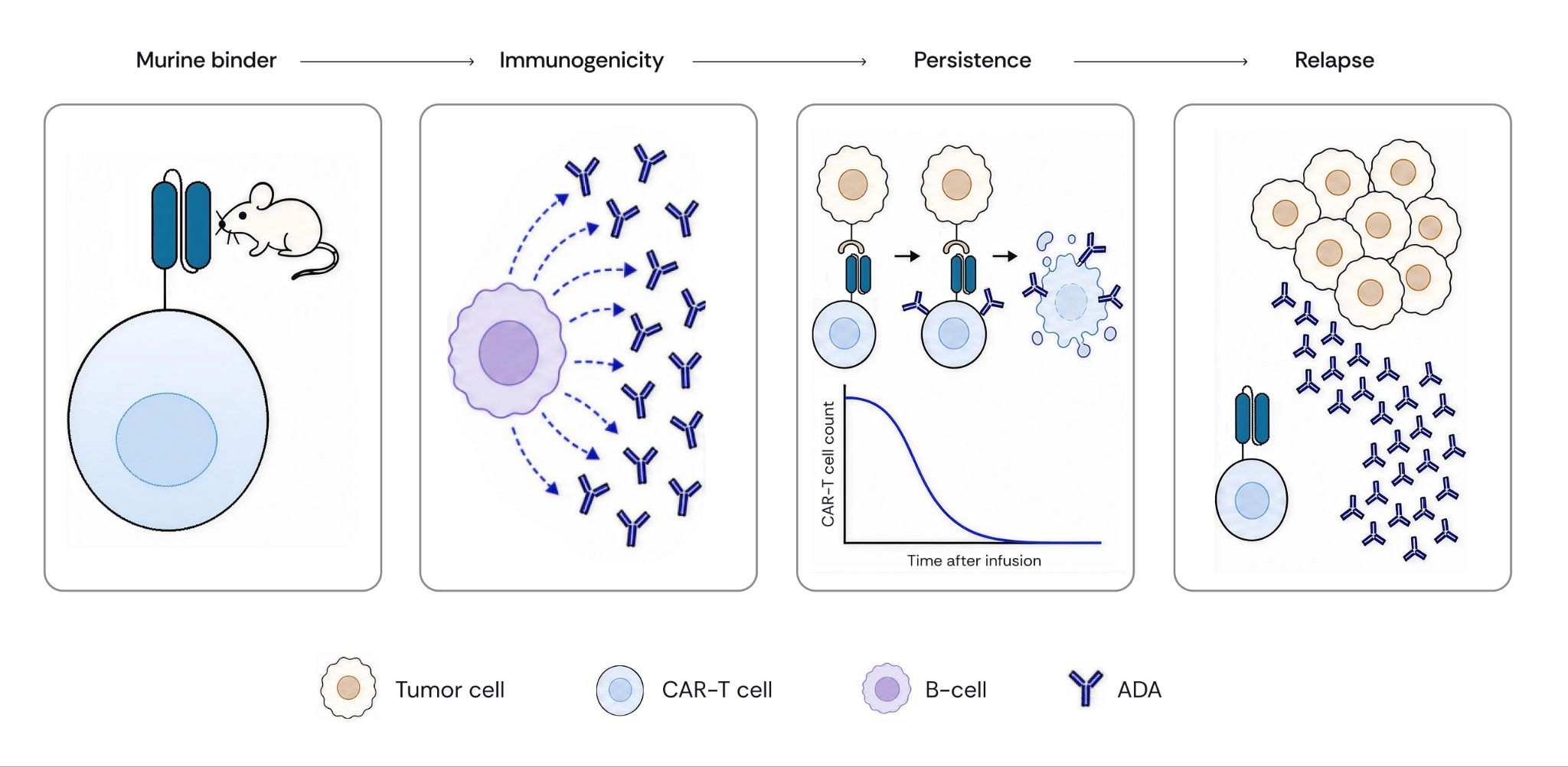
A breakdown of why the murine scFv puts a ceiling on CD19 CAR-T treatments, and how humanizing the sequence breaks through it. (Converge Bio)
What AI can and can't do here
Let's not kid ourselves. Most drugs fail. Even a biobetter still demands a ton of trials, and most of them will fail. But they'll fail less often than a drug that starts from nothing. AI cannot speed up most of the critical, expensive parts of drug development. There's a reason this costs billions and fails over and over, even when it "saves" the mice. Just a few days ago there was another example, a Novo Nordisk trial that hit its mark in Phase II and then failed in Phase III. The biological effect was real, but it didn't improve mortality once they tested it on a larger group of patients.
There are endless examples of how little success in mice tells you about success in humans. AI can't prove that a drug extends life, or that it doesn't cause harm. It can improve trial design, patient recruitment, site selection, monitoring, and data analysis. What it can't do is erase biological uncertainty and the clinical trials themselves, or cut many years off how long this whole process takes.
The patent isn't born in the clinical trial. It's born in the sequence.
And yet the Converge Bio example shows exactly where AI does get into drug development, and it isn't a minor point. That sequence is the foundation and the core of the IP. It's one of the very few stages of drug development that AI actually looks able to compress, and it happens to be the stage that decides who ends up holding the multi-billion-dollar asset.
Originally published as a thread on X by Shahar Tzafrir. Read the original thread here.