Case Study

Iddo Weiner
|
Jan 7, 2026
How ConvergeCELL’s Virtual Cell identifies clinically relevant biomarkers and therapeutic targets—without indication-specific fine-tuning.
Modern biomarker discovery is often constrained by narrow indication-specific models, limited datasets, and long iteration cycles. In this case study, we demonstrate that ConvergeCELL can robustly identify established biomarkers and prioritize novel targets across multiple disease areas using a true zero-shot approach, even when data is sparse and heterogeneous.
The challenge
Biomarker and target discovery becomes increasingly difficult as programs move beyond well-characterized indications. In practice, teams face:
Highly variable cohort sizes across disease areas
Noisy or incomplete clinical datasets
Limited opportunity for extensive model tuning per indication
Pressure to identify both known benchmarks and novel candidates early
The key question we set out to answer was: Can a single, indication-agnostic system reliably recover known biology while surfacing new insights across diverse disease states, without disease-specific optimization?
Objective
Evaluate ConvergeCELL’s “Virtual Cell” capability to identify:
Established clinical biomarkers
Known therapeutic drug targets
Putative novel biomarker candidates
across multiple, biologically distinct disease states using a zero-shot workflow, with no indication-specific fine-tuning.

Study design and methods
To reflect real-world conditions, we curated patient cohorts spanning four disease areas with deliberately varied dataset sizes:
Crohn’s disease: 150 disease / 75 control
Lung cancer: 171 disease / 21 control
Diabetes: 5 disease / 6 control
Parkinson’s disease: 6 disease / 6 control
Analytical workflow
Zero-shot application of ConvergeCELL
ConvergeCELL was applied without any indication-specific training or tuning.
Prioritization via ConvergeCELL score
Outputs were ranked using a ConvergeCELL-derived scoring framework.
Benchmarking and validation
Results were compared against:
Standard Differential Expression (DE) approaches
Established biological knowledge from Open Targets
Automated literature validation
ConvergeCELL’s automated literature review system was used to:
validate nominated novel candidates
generate potential mechanisms of action
This approach mirrors how discovery teams operate under real clinical constraints.
Results
Across all four disease indications, ConvergeCELL delivered consistent and robust performance.
Key outcomes
Successfully identified established biomarkers and known therapeutic targets across all indications
Identified novel biomarker candidates supported by literature evidence
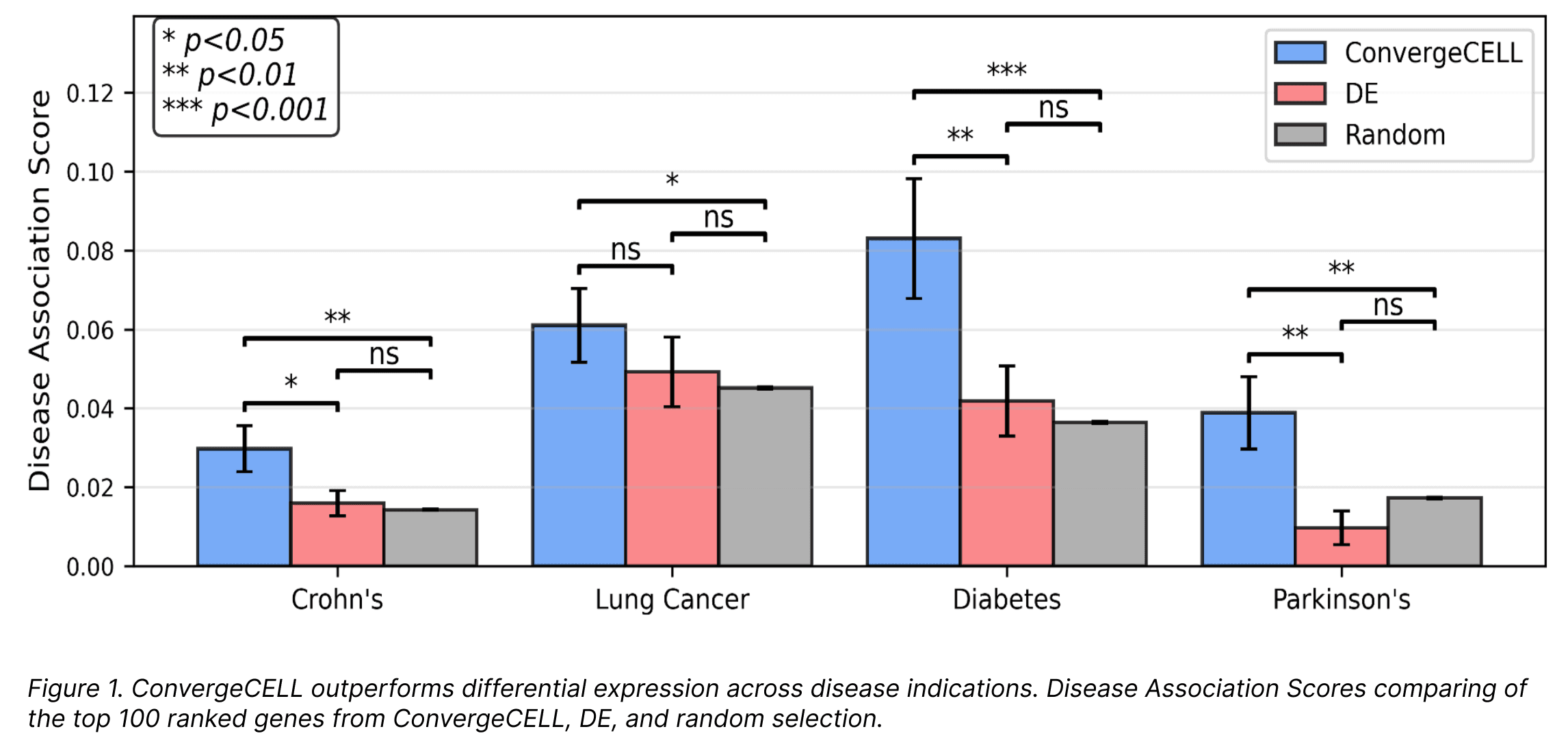
Outperformed differential expression (DE) approaches in all four indications
Demonstrated improved ranking quality, including:
NDCG
Kappa
Gamma scores
These metrics confirm that ConvergeCELL’s prioritization aligns closely with existing scientific literature—while extending beyond it to propose new hypotheses.
Example: diabetes biomarker prioritization
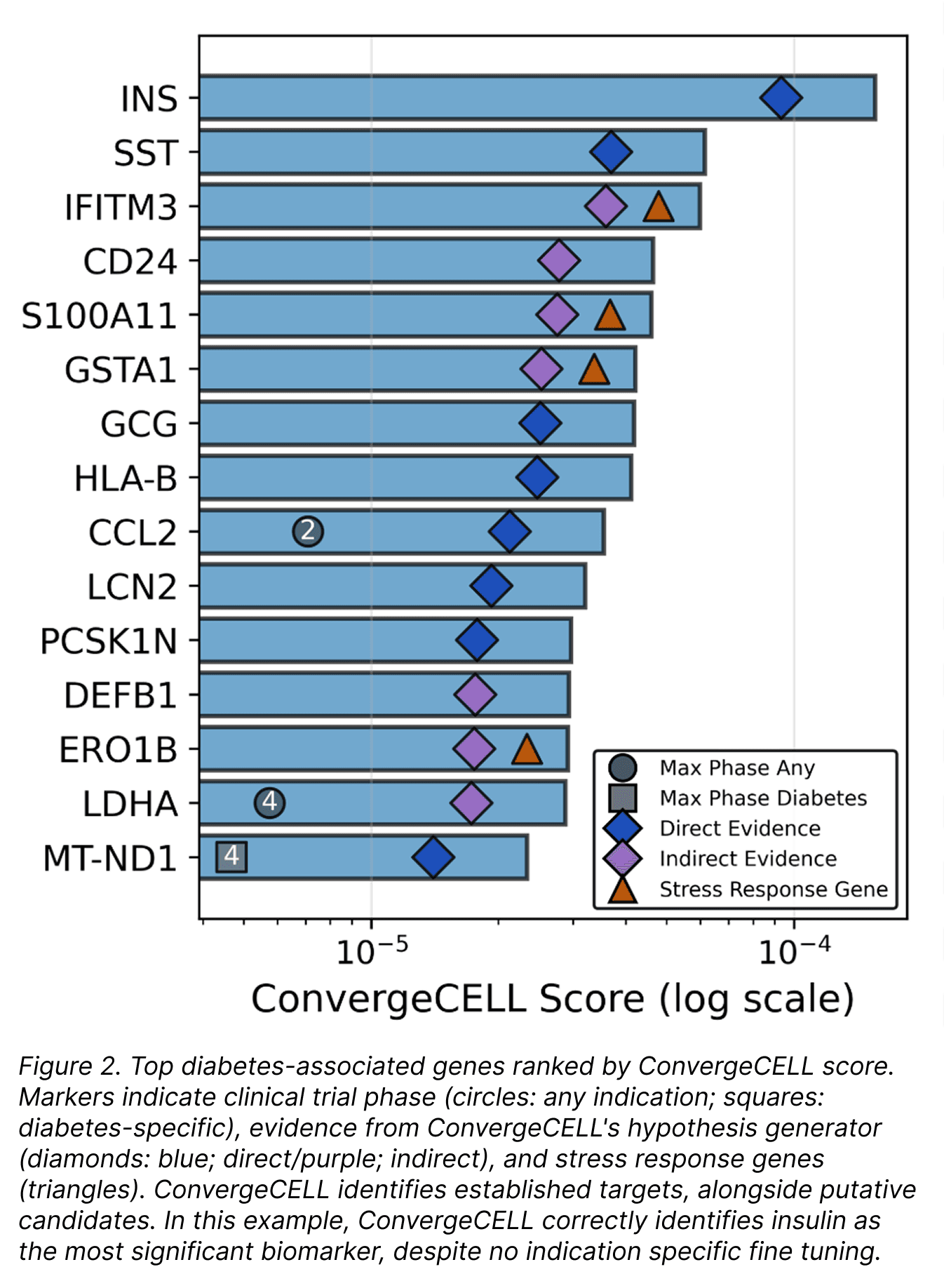
In the diabetes cohort, ConvergeCELL ranked top diabetes-associated genes while simultaneously distinguishing:
established clinical biomarkers, and
novel candidates supported by hypothesis generation and literature signals
Notably, ConvergeCELL correctly identified insulin as the most significant biomarker despite the absence of indication-specific tuning, highlighting its ability to recover core disease biology even in small datasets.
Why this matters
This study demonstrates that ConvergeCELL is not optimized for a single disease or benchmark; it is built to generalize across biological systems.
ConvergeCELL enables discovery teams to:
Confidently prioritize biomarkers and targets across multiple indications
Extract value from limited or uneven clinical datasets
Reduce dependence on manual curation and disease-specific modeling
Accelerate early discovery while maintaining biological credibility
In short: ConvergeCELL performs where real-world discovery happens, not just in idealized datasets.
Conclusion
ConvergeCELL has demonstrated that it is a reliable, indication-agnostic engine for biomarker and target discovery, capable of operating effectively across a broad spectrum of disease states, even when data is limited and indications are novel.
This capability is essential for modern discovery programs seeking speed, scalability, and biological rigor.
Click here to learn more about ConvergeCELL™.
Click here to contact the Converge team.