Blog
Iddo Weiner, Converge Bio, Co-founder & CSO
|
Key takeaways
AI drug discovery saves the most time at the front of the pipeline. Target identification and hit generation used to eat years of manual work, and that is where the gains show up first.
The early stages benefit most. The latter ones still rely solely on wet-lab validation and clinical trials, and no model changes have been made.
AI in pharma changes how teams work more than how many people they need. Scientists spend less time dreaming up hypotheses by hand and more time deciding which of the model's ideas are worth chasing.
The right tooling depends on your strategy. A team polishing existing leads needs something completely different from one designing biologics from scratch.
Converge Bio supports work across the whole drug discovery pipeline, from target discovery through antibody design and biomanufacturing yield, so teams can apply AI wherever it helps them most.
What is AI drug discovery?
AI drug discovery is the use of machine learning and generative models to propose, rank, and refine drug candidates faster than people can by hand. Rather than screening compounds or designing molecules by trial and error, teams train models on biological and chemical data and let those models predict which candidates are worth the effort.
Why is pharma bothering? Because the old pipeline is brutally slow and expensive, and most candidates die anyway. A drug that reaches approval usually represents more than a decade of work and billions in sunk cost, most of it spent on molecules that never made it. AI does not make failure go away. It changes when the failure happens. Killing a doomed candidate in a model run instead of a Phase II trial is, more or less, the entire business case.
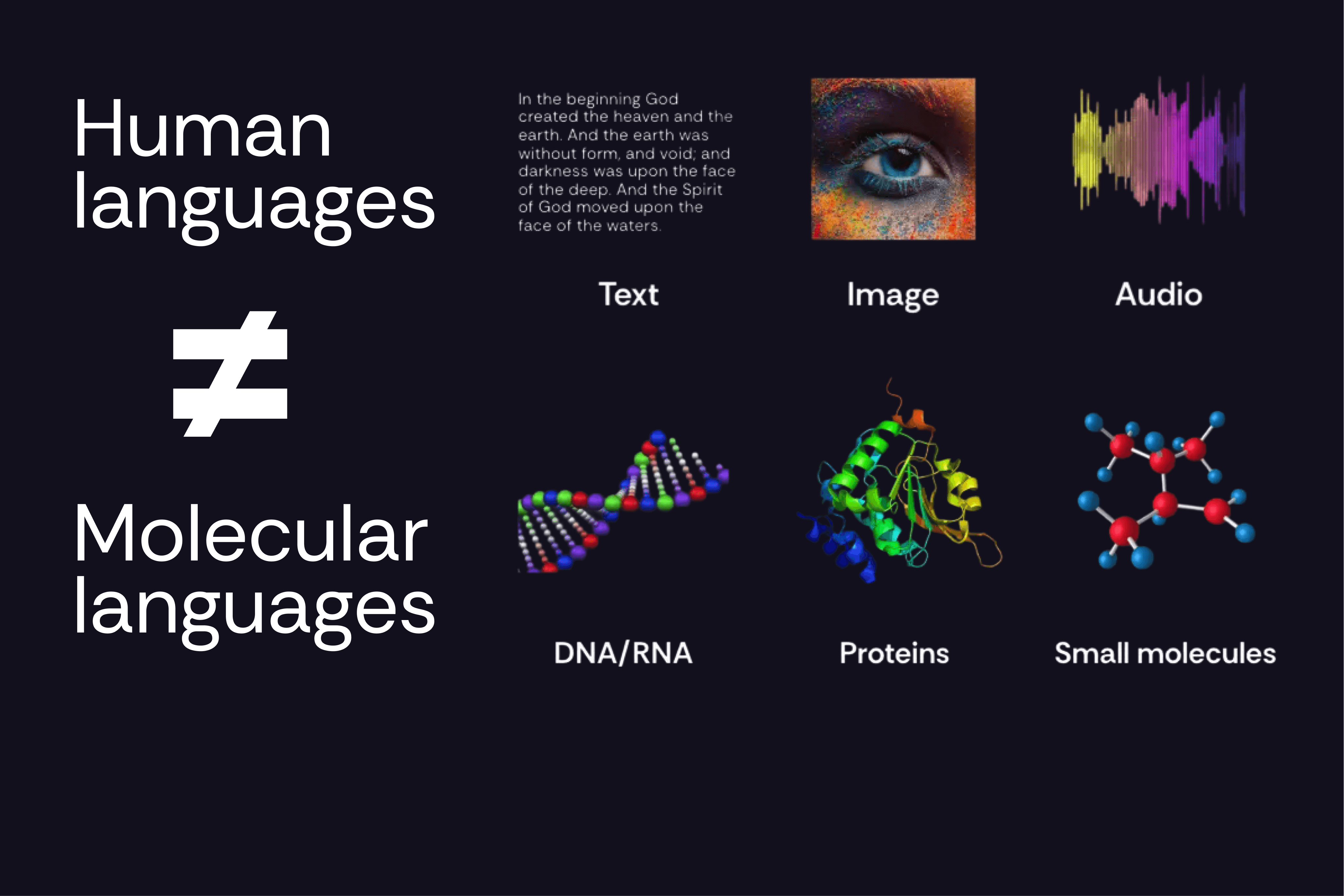
Then there is the data. Biology now throws off enormous, structured datasets, from genomic sequences to protein structures to high-content screening images. No team can read its way through all of that. Models can.
How AI is reshaping each stage of the pharma pipeline
The pipeline runs from understanding disease biology to proving a molecule is safe and effective in people. AI touches every stage, but not evenly, and it is worth being honest about where it earns its keep.
Target identification and validation
This is where AI has moved fastest. Models trained on genomic, transcriptomic, and proteomic data can rank which genes or proteins most likely drive a disease, and which ones you can actually drug.
The hypotheses now come from data-led ranking, not just from reading the literature, and causal inference helps you tell the real drivers apart from the bystanders riding along with them. The thing to remember is that the model gives you a shortlist, not an answer. Spend the time to understand why a target scored highly before you pour resources into it.
Hit generation and lead discovery
For small molecules, generative models design candidates against a target. For biologics, they design the protein sequences directly.
So instead of screening a giant physical library, you generate a focused set on the computer and test only the best of it. This lives or dies on the loop between design and lab readout. Feed the model clean results from your own assays, and it gets sharper fast. Feed it noise, and it will happily give you noise back.
Lead optimization
This stage is refinement: better potency, better selectivity, and the unglamorous properties that decide whether a molecule can survive as a drug at all.
Models predict how a structural edit changes binding, stability, and off-target behavior, so you test fewer variants. One catch worth stating plainly: define what you are optimizing for up front. A model will only chase the goals you actually hand it, and "make it better" is not a goal.
Preclinical development
Here AI helps predict absorption, distribution, metabolism, excretion, and toxicity, plus the formulation and manufacturability questions that tend to bite later.
Those predictions flag problems before you run animal studies, which narrows the field. Use them to triage, not to cut corners. Regulators still expect the preclinical evidence they always have, and no prediction substitutes for it.
Clinical development
This is where AI is youngest, though it is growing: patient stratification, trial design, site selection, biomarker discovery.
Pick the right patients and you can lift trial success rates and shorten enrollment. But AI stays in the back seat here. Clinical endpoints and regulatory standards still decide what counts as evidence, and they are not negotiable.
For a closer look at how far this has come in practice, see the race for the first AI-discovered medications.
What actually changes for pharma teams
Mostly, where scientists spend their time. Less of it goes to brute-force screening and hand-built hypotheses. More of it goes to asking the right questions, cleaning up training data, and poking holes in whatever the model returns.
A few things shift in practice. The daily work moves from running the experiment to figuring out which experiments the model says are worth running. Your data becomes an asset in its own right, and clean, well-labeled proprietary data is often worth more than the model sitting on top of it. And people have to talk to each other more. Biologists, chemists, and ML folks need enough of each other's vocabulary to trust a result, and to call it out when it looks wrong.
Some things do not budge. Wet-lab validation stays, because a prediction is just a hypothesis until an experiment says otherwise. Clinical trials stay, because nothing shortcuts proving safety and efficacy in humans. Judgment stays, because the model hands you candidates but you still decide which ones to back, and why.
Here is the part that gets lost in the hype. AI lets a small team explore far more than it used to, but the bar for rigor has not moved an inch. The ceiling went up. The floor is exactly where it was.
How pipeline strategy shapes the AI tools you need
There is no one AI drug discovery platform that fits everyone, because the bottleneck is different depending on what you are trying to do.
Stuck finding the right target? You need models built on causal biology and multi-omic data, not a molecule generator. Designing biologics? You need protein and antibody tools that handle sequence, structure, and developability at the same time, because treating them separately is how good candidates fall apart late. Fighting yield? You need models tuned to expression and manufacturing, which look nothing like discovery models.
This is why ai drug development is turning into a stack-building exercise rather than a single purchase. Map your pipeline, find the stage where AI actually moves the needle, and start there. Converge Bio's products are built along these lines, with separate systems for target discovery, antibody design, and biomanufacturing yield, so you can put AI where your pipeline needs it instead of forcing one model to be good at everything, which usually means it is good at nothing.
The real question was never whether to use AI. It is which stage of your pipeline pays you back the most for it. For a broader view of where this is all heading, see when will we have the GPT moment in biology.
FAQ
How does AI speed up drug discovery?
AI ranks targets and generates candidates on the computer, so teams test fewer but better-chosen options. The biggest savings come early, in target identification and hit generation, where models replace slow manual screening and literature review with a shortlist that points the lab work in the right direction.
What types of AI are used in drug discovery?
Several. Predictive machine learning ranks targets and forecasts molecular properties. Generative models design new proteins or small molecules. Foundation models trained on genomic and transcriptomic data support target discovery. Causal inference separates real disease drivers from correlated bystanders. Most real programs use several of these together rather than betting on one.
Does AI replace traditional lab testing in the drug discovery pipeline?
No. AI narrows down what to test and guesses at the outcome, but every promising candidate still needs wet-lab validation. Predictions are hypotheses. The lab decides whether a molecule really binds, works, and behaves safely, and clinical trials are still mandatory before anything reaches patients.
How accurate are AI predictions in drug discovery?
It depends a lot on the task and the data behind it. For well-studied properties on clean data, predictions can be strong. For novel biology or thin data, they get shaky. That is why teams treat predictions as a way to prioritize, not as answers, and confirm the top candidates in the lab before committing real money.