Iddo Weiner
|
Jan 6, 2026
In antibody development, some of the most critical failure modes don’t announce themselves loudly. Solubility is one of them.
It’s a deceptively basic molecular property with outsized consequences. Poor solubility can derail otherwise promising antibody candidates by driving aggregation, increasing viscosity, complicating formulation, and ultimately triggering late-stage failure. By the time these issues surface experimentally, significant time and resources have often already been invested.
The challenge is that solubility is notoriously difficult to predict early. It arises from a complex interplay of sequence features, three-dimensional structure, surface charge, and hydrophobic patches. That complexity has historically limited the effectiveness of purely computational approaches—and left many teams reliant on downstream experimental screening.
Measuring Solubility with HIC
One of the most widely used experimental assays for antibody solubility is hydrophobic interaction chromatography (HIC).
HIC measures how strongly an antibody interacts with hydrophobic surfaces under salt-stress conditions, providing a practical proxy for overall molecular hydrophobicity. In simple terms, antibodies with higher hydrophobicity tend to stick longer to the column and exhibit longer retention times. More developable antibodies, by contrast, generally show shorter retention times and lower HIC values.
While HIC is highly informative, it is still an experimental readout—meaning it typically comes into play after candidate generation, not before.
Predicting Solubility with Generative AI
At Converge Bio, solubility prediction is a core component of ConvergeAB™, our generative AI platform for antibody design and optimization.
Within ConvergeAB™, we design and rank antibody candidates across multiple developability dimensions, including solubility. Our solubility model integrates both sequence-level and structure-level features, allowing it to capture the nuanced drivers of hydrophobicity that simpler heuristics miss.
The model is trained on an extensive body of proprietary experimental data generated from ConvergeAB™ de novo antibody designs, complemented by carefully curated and harmonized public datasets. This combination enables robust generalization beyond any single antibody family or scaffold.
Model Performance That Translates to Decisions
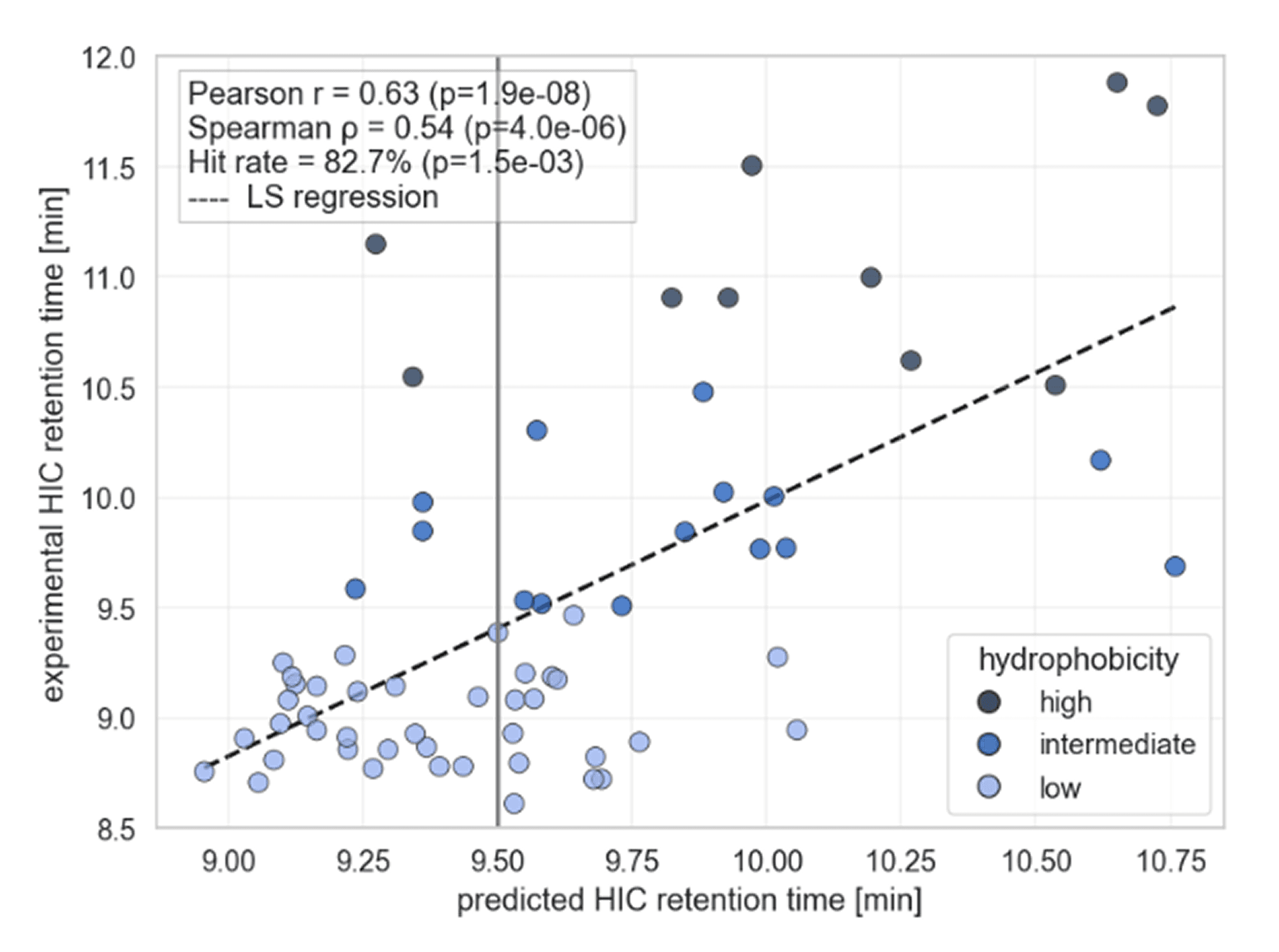
In a regression task predicting experimental HIC retention times for previously unseen, homology-contr
olled antibodies, our model shows strong, statistically significant correlations across both value-based and rank-based metrics.
But performance metrics alone aren’t the real test.
What ultimately matters is how the model performs in production—when it is used to make real design and selection decisions. When we filter for candidates with low predicted hydrophobicity (HIC < 9.5), the model achieves an 83% hit rate (24 out of 29 antibodies meeting the experimental criterion).
That level of precision turns solubility from a late-stage risk into an early, actionable signal.
De-Risking Antibody Programs Earlier
By accurately predicting solubility before experimental screening, ConvergeAB™ helps teams focus resources on candidates that are not only potent and specific, but also manufacturable and formulation-ready.
Solubility may be a quiet deal-breaker—but with the right data and models, it doesn’t have to be a surprise.
At Converge Bio, we’re using generative AI to surface these risks early, when they are cheapest and easiest to fix.
Learn more about ConvergeAB