Blog

Converge Team
|
Patents contain some of the most valuable scientific information in antibody discovery. Long before a therapeutic reaches the clinic or appears in publications, critical details about sequences, variants, binding characteristics, and engineering approaches are often disclosed in patent filings.
For discovery scientists, computational biologists, and antibody engineers, patents represent an enormous source of competitive and scientific intelligence. The challenge is that extracting useful information from patents is often tedious, manual, and time-consuming.
Scientists regularly spend hours reviewing lengthy patent documents, locating sequence listings, comparing variants, and transferring data into spreadsheets for downstream analysis.
To make this process easier, Converge has developed a free online Patent Extractor tool that helps researchers quickly identify and organize antibody-related information from patent documents.
Why Discovery Teams Extract Antibody Intelligence from Patents
Patents are often the earliest public source of information about therapeutic antibody programs. They can reveal:
Candidate molecules
Sequence variants
CDR information
Engineering strategies
Binding and affinity data
Target-specific development approaches
For research and discovery teams, patent intelligence supports a wide range of activities:
Lead optimization
Target evaluation
Competitive landscape assessment
Dataset generation
Sequence comparison
Prior art review
Many organizations also use patent-derived information to enrich internal research workflows and support decision-making across discovery programs.
Because patents frequently contain information that is unavailable elsewhere, they have become an important resource for both experimental and computational teams.
How Is Antibody Data Extracted from Patents Today?
Despite their value, patents remain difficult to work with.
Most scientists still rely on highly manual workflows that involve:
Downloading patent PDFs
Searching through hundreds of pages
Identifying relevant sequence listings
Copying sequences into spreadsheets
Reformatting tables
Organizing extracted data for further analysis
This process becomes even more challenging when dealing with:
Multiple sequence variants
Large patent families
Complex numbering systems
Extensive experimental sections
Inconsistent formatting
Many teams perform this work repeatedly across dozens or even hundreds of patents.
As a result, valuable scientific time is often spent on data collection rather than scientific interpretation.
This challenge has created growing interest in automated antibody sequence extraction workflows that can transform patents into structured, usable datasets.
Introducing the Converge Patent Extractor Tool
The Converge Patent Extractor is a free online tool designed to help researchers quickly extract antibody-related information from patent documents.
Rather than manually searching through lengthy filings, scientists submit a patent ID (e.g., US6217866) and receive structured outputs that are ready for downstream analysis.
The tool is built specifically for antibody-focused workflows and helps organize information that would otherwise require extensive manual review.
With the Patent Extractor, users can:
Identify relevant antibody sequences with full functional data
Extract CDR information
Capture sequence variants
Organize experimental data
Structure patent-derived information for further research
The goal is simple:
Turn complex patent documents into usable scientific intelligence.
The tool is available free of charge and can be accessed here:
For teams involved in antibody patent analysis, this significantly reduces the effort required to move from raw patent documents to actionable data.
How to Use the Patent Extractor: Step by Step
Getting started requires only a few steps.
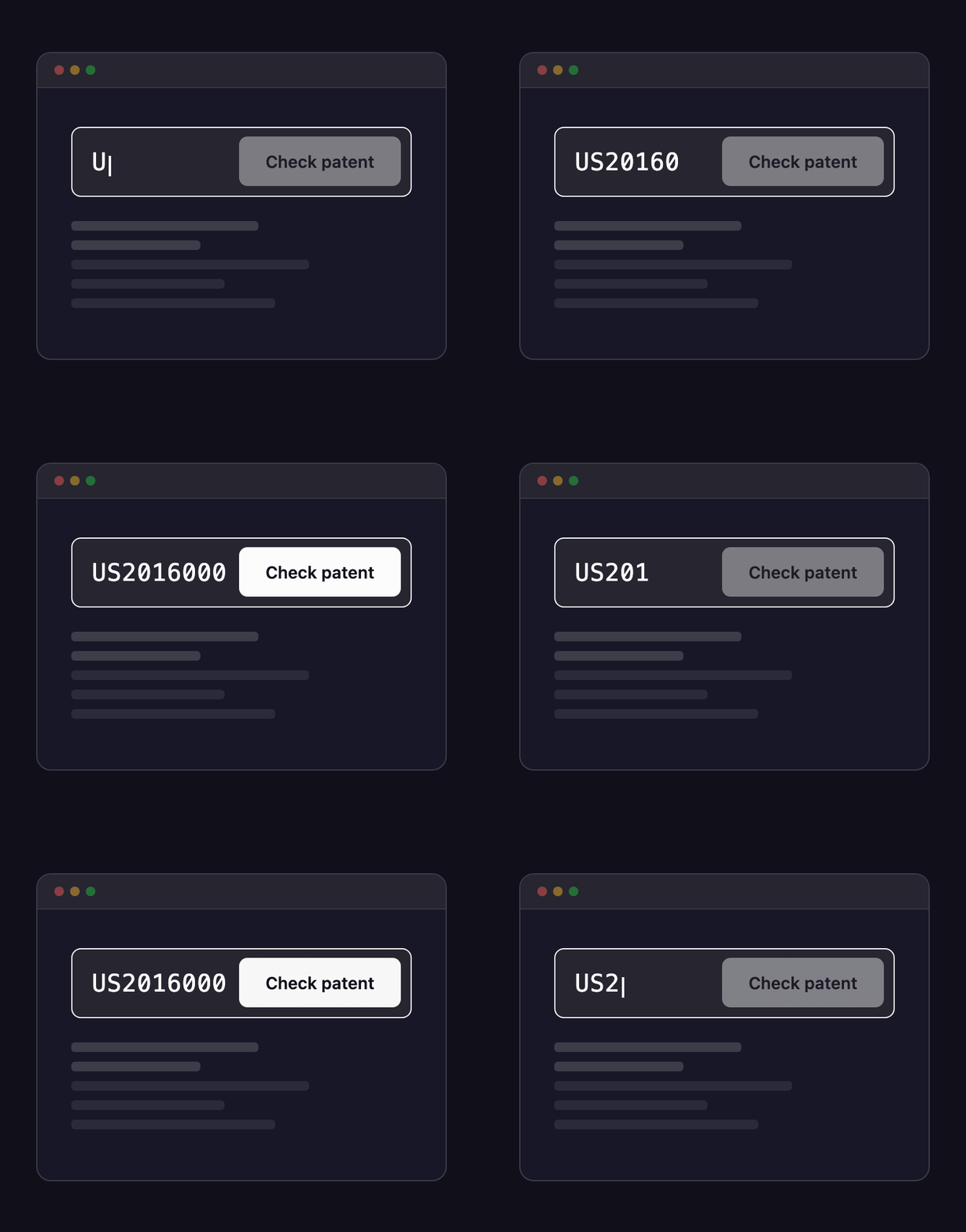
Step 1: Submit a Patent
Provide the patent ID you would like to analyze.
The system will begin processing the document automatically.
Step 2: Wait for Processing
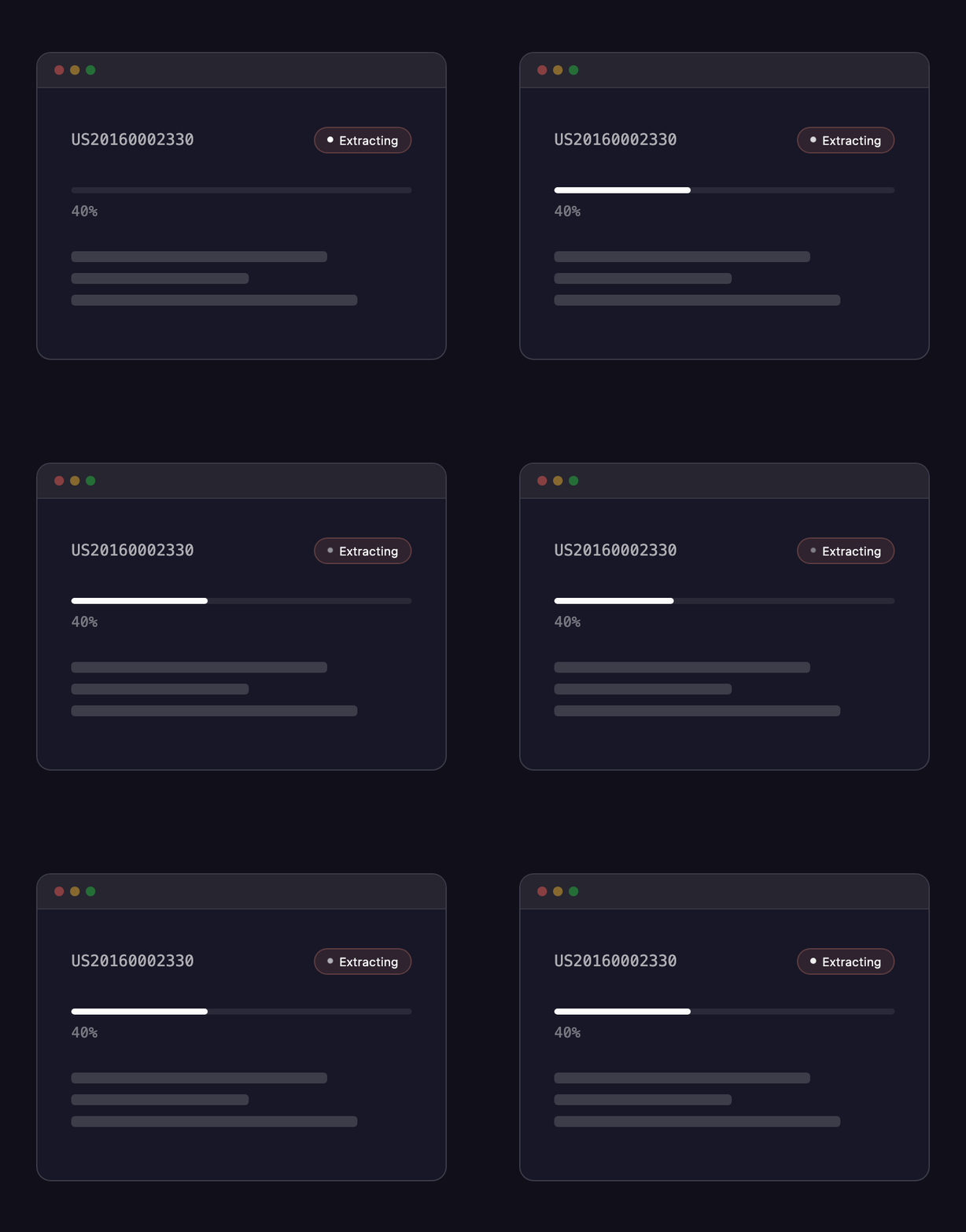
The extractor reviews the patent and identifies relevant antibody-related content.
Depending on document complexity, processing may take up to a few hours.
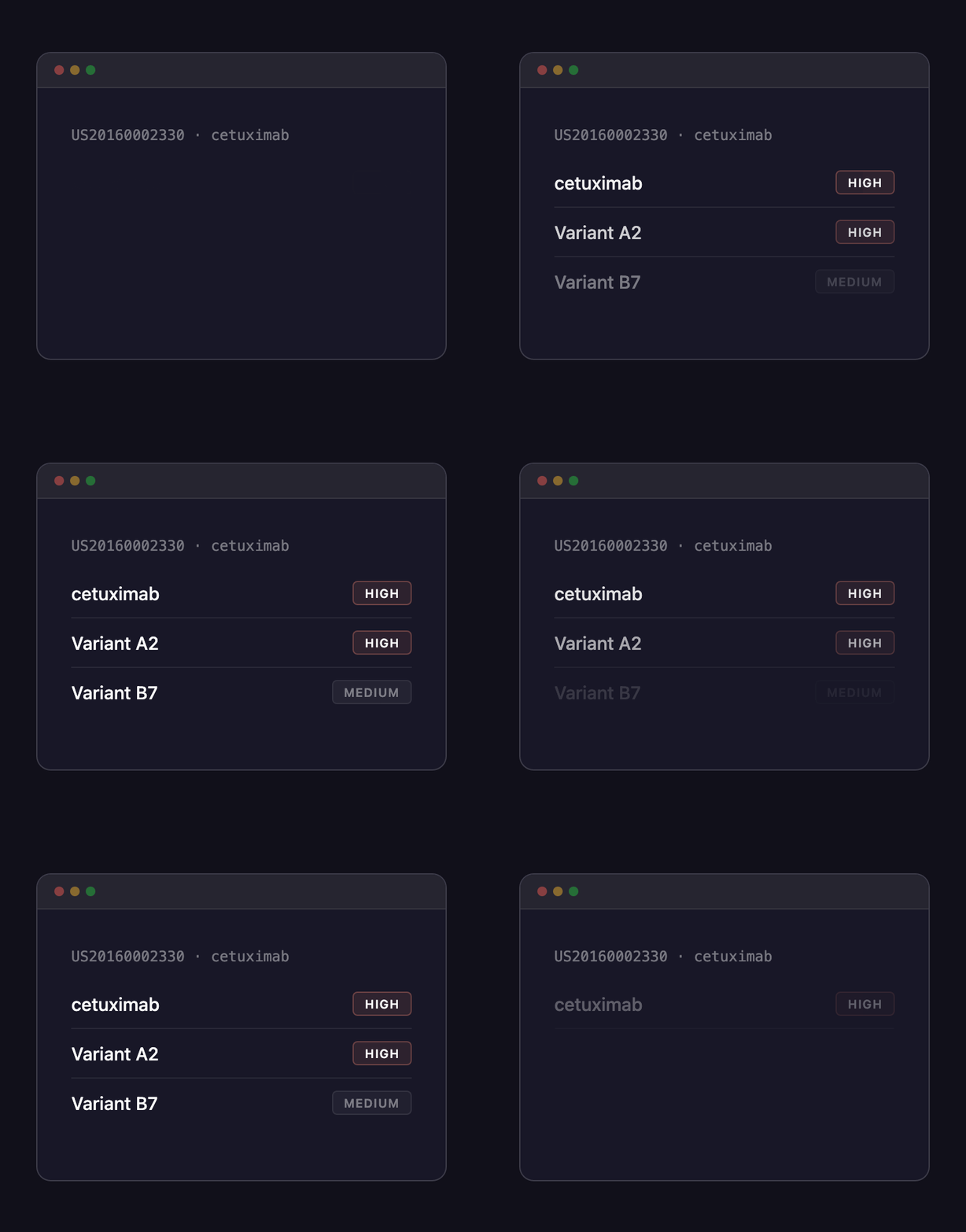
Step 3: Review Results
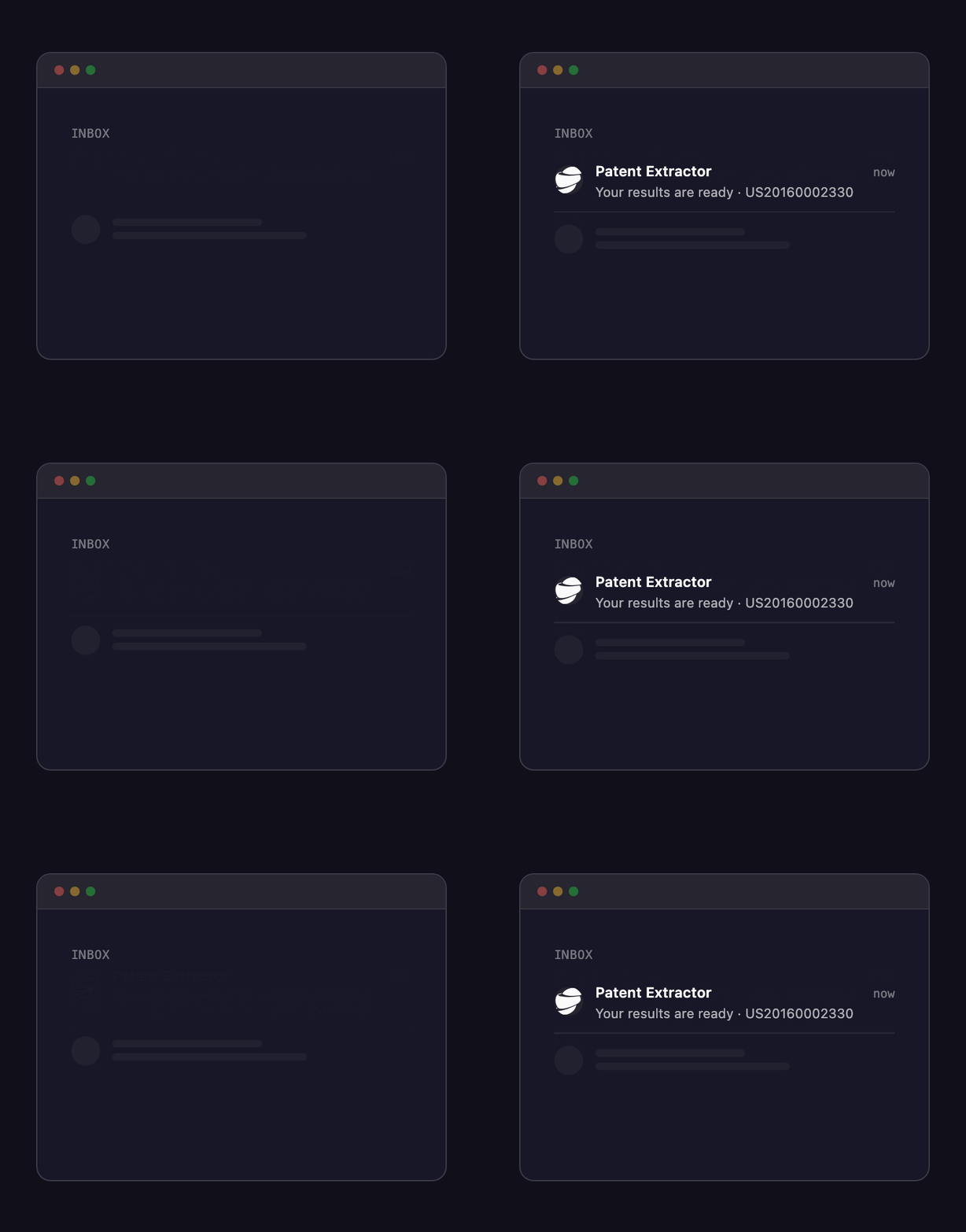
Once complete, structured outputs become available for exploration. Users will receive an email to access the results.
Users can review extracted information and identify relevant sequences and supporting data.
Step 4: Export and Analyze
The extracted information can then be incorporated into downstream research workflows, comparative analyses, or internal datasets.
The entire process is designed to reduce manual effort while improving accessibility of patent-derived information.
What You Can Do with Extracted Antibody Sequences
Patent-derived antibody data becomes significantly more valuable once it has been organized into a structured format.
Researchers use extracted information for a variety of applications, including:
Lead Optimization
Discovery teams can compare variants, identify engineering strategies, and evaluate candidate molecules disclosed in patents.
Competitive Intelligence
Patent data helps researchers understand how other organizations are approaching a target, modality, or therapeutic area.
Sequence Analysis
Scientists can evaluate sequence relationships, identify similarities, and investigate diversification strategies across disclosed antibodies.
Dataset Generation
Computational biology and AI teams frequently require structured sequence datasets for model development and research workflows.
Internal Knowledge Management
Patent information can be incorporated into internal repositories, making scientific intelligence easier to access and share across teams.
Research Planning
Structured patent information helps support hypothesis generation and informs future discovery decisions.
Many organizations combine patent-derived information with internal datasets, literature findings, and public resources to create a more complete view of the antibody landscape.
In this context, patents serve as an important complement to an existing antibody sequence database or other scientific resources.
Similarly, teams conducting antibody patent search activities can use extracted information to accelerate evaluation and comparison workflows.
For organizations involved in antibody patent mining, automation helps scale analysis efforts while reducing manual review time.
Patent-derived information may also complement data sourced from a broader therapeutic antibody patent database, helping researchers build a more comprehensive understanding of the competitive landscape.
Why Automated Patent Extraction Matters
As antibody discovery programs become increasingly sophisticated, the volume of available patent information continues to grow.
Manual approaches that worked for reviewing a handful of patents often become unsustainable at larger scales.
Our automated patent extraction tool offers several advantages:
Faster access to relevant information
Reduced manual workload
Improved consistency
Better support for computational workflows
Easier collaboration across teams
Most importantly, it allows scientists to spend more time interpreting data and less time collecting it.
Researchers should focus on scientific decisions—not repetitive data extraction tasks.
FAQs
What is an antibody patent sequence extractor?
An antibody patent sequence extractor is a tool that identifies and organizes antibody-related sequence information from patents. It helps researchers quickly locate relevant sequences and convert unstructured content into data that can be reviewed, analyzed, and incorporated into downstream discovery workflows.
Can I extract CDR sequences from a patent using this tool?
Yes. The Converge Patent Extractor is designed to identify and organize antibody-related information contained within patent documents, including CDR-related content when available. Results depend on how information is disclosed within the original patent filing and its underlying structure.
Is the Converge Patent Extractor free to use?
Yes. The Patent Extractor is free, with a limit on the number of patents each user email can submit. The cap is set so individual scientists can run extractions on the patents that matter most to their work. For higher-volume access, get in touch.
What file or input formats does the tool accept?
You can paste a US, EP, or WO patent ID. The supported input formats may evolve over time. Visit the Patent Extractor page for the latest information regarding accepted file types, submission requirements, and processing workflows.
What am I allowed to do with the results?
Users can review, analyze, export, and incorporate extracted information into their research workflows, subject to applicable intellectual property considerations and organizational policies. Researchers should always evaluate how extracted data will be used within their specific scientific and legal context.
How accurate is it?
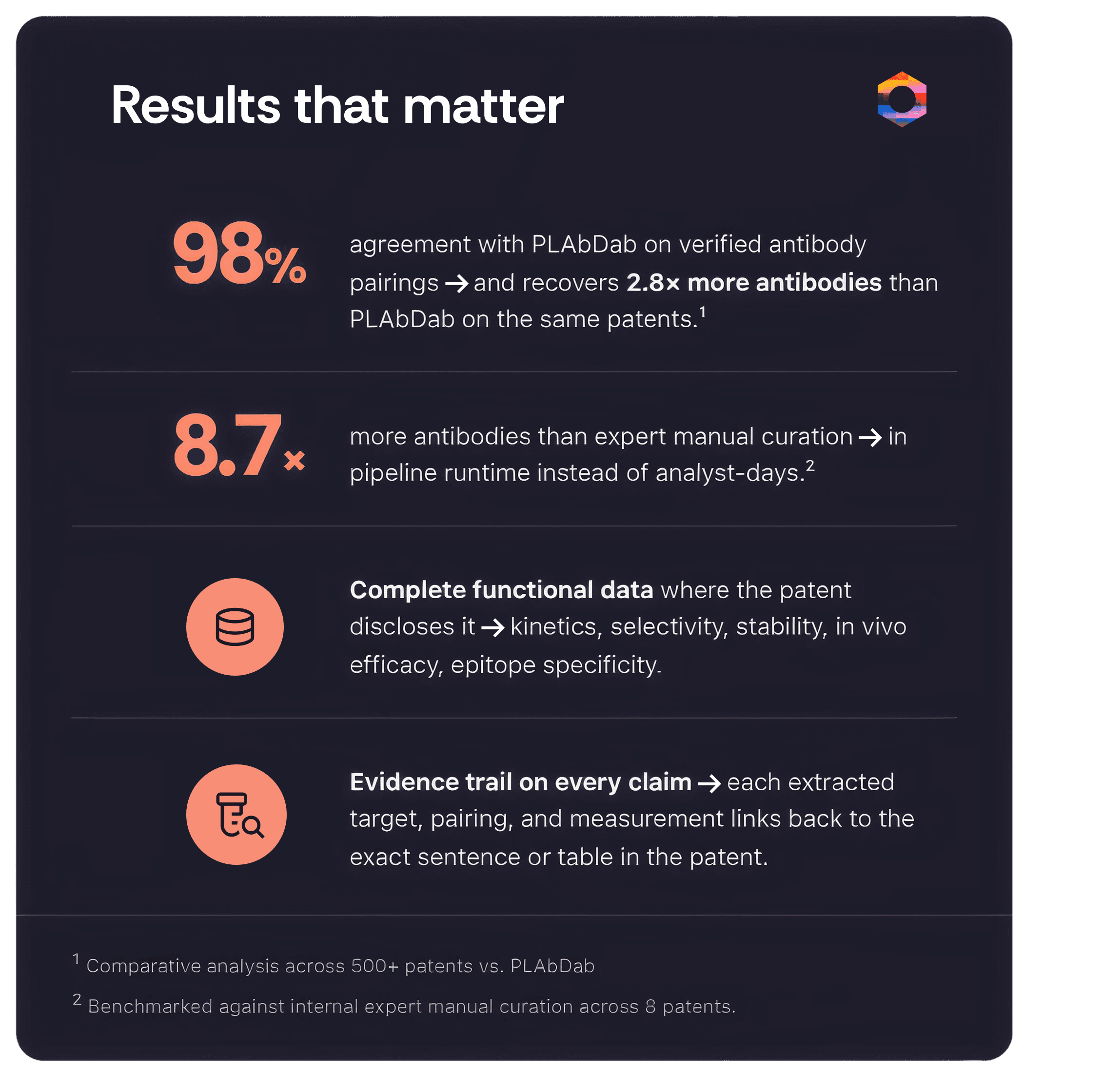
On a benchmark of 500+ patents, our antibody pairings agree with 98% of PLAbDab's verified entries, while recovering 2.8× more antibodies overall. Against expert manual curation across 8 patents, the pipeline returned 8.7× more antibodies in pipeline runtime versus analyst-days. Every extracted target, pairing, and measurement links back to its source sentence or table in the patent, so you can audit any claim.
What patents does this actually work on?
The tool is built for antibody patents and handles US, EP, WO, and AU identifiers. It reads ST.26 XML, ST.25 listings, pre-ST.25 prose, FASTA dumps, and scanned PDFs (via vision OCR). Currently, catents covering small molecules or non-antibody biologics fall outside current scope.
Does this give me FTO?
No. The Patent Extractor surfaces the disclosed scientific content, like sequences, targets, modalities, functional data, etc. Not the legal claim scope. For FTO opinions or claim-scope analysis, consult your IP counsel.
Start Extracting Antibody Intelligence Today
Patent documents contain an extraordinary amount of scientific value, but manually collecting that information can slow down discovery efforts.
Converge’s Patent Extractor helps researchers move from unstructured patent documents to organized scientific data faster and with less effort.
If you're looking to extract antibody sequences from patents and accelerate patent-driven research workflows, try the Converge Patent Extractor today:
To learn more about Converge’s antibody solutions:
To talk with our experts: